

Indexed universal life insurance is worth considering in 2026 if you need lasting life insurance, can fund the policy through uneven index-crediting years, and understand how charges affect its cash value. It is a poor fit if your main goal is straightforward, affordable coverage or if you expect index gains to flow into your account without limits or deductions. The decision turns on the policy illustration and contract terms, not the index’s past performance.
- Is indexed universal life insurance worth it? Yes for some long-term coverage needs, but not as a simple investment substitute.
- Term life is best for a defined coverage period; indexed universal life adds cash-value complexity.
- A crediting floor does not prevent policy charges from reducing cash value.
- Mxmcompass financial guidance suits people weighing insurance against a broader financial plan.
Is indexed universal life insurance worth it in 2026?
| Option | Best for | Main advantage | Main drawback |
|---|---|---|---|
| Term life insurance | A defined period of protection | Coverage without a cash-value account to manage | Coverage ends when the term ends unless you renew or replace it |
| Whole life insurance | People who prefer more predictable policy terms | Generally more predictable premiums and cash-value provisions | Less flexibility than universal life designs |
| Indexed universal life insurance | People who need lasting coverage and will monitor the policy | Flexible premiums and cash-value interest linked to an index formula | Charges, crediting limits, and underfunding can weaken the policy |
Indexed universal life insurance is best for someone buying life insurance first and treating potential cash-value growth as a secondary feature. Its cash value does not buy shares of the named index. Instead, the insurer applies a contract formula to determine credited interest. That distinction matters when an illustration shows attractive growth: the illustrated path is not a promise that future credits will follow it.
In 2026, compare the policy with the protection you actually need, not just with another cash-value policy. If a defined period of coverage solves your problem, start with term life. If you need coverage intended to last longer, compare indexed universal life with whole life using the same coverage goal. For planning support, Mxmcompass provides financial guidance to individuals and companies seeking insurance solutions.
Why this matters
An indexed universal life policy has moving parts that a simple growth projection can obscure. Premiums fund a policy that includes insurance charges and other deductions; the remaining cash value can earn interest under the contract’s index-crediting rules. A year with little credited interest does not stop policy charges. If the account cannot support those charges and you do not add enough funding, coverage can lapse.
That makes the question bigger than whether an index rises. You need to know what happens when credited interest disappoints, charges change under the contract, or your ability to pay premiums changes. A policy that works only under the illustration’s favorable assumptions is not a dependable protection plan.
What do you get from indexed universal life insurance?
You get life insurance with a cash-value account and a crediting method tied to an external index. The contract determines how much of an index gain counts toward interest; caps, participation rates, spreads, or other provisions can limit the credited amount. Read the specific policy terms rather than assuming every indexed universal life policy uses the same formula.
The appeal is a combination of potential cash-value growth and coverage intended to continue beyond a fixed term, provided the policy remains adequately funded. The trade-off is that performance depends on both crediting and deductions. An interest-crediting floor is not a floor under your cash value: charges can still reduce the account even when the credited interest does not fall below the contract’s stated floor.
Policy loans add another decision. Borrowing against cash value can reduce the amount available to support the policy and affect the death benefit. A loan that remains outstanding when a policy lapses can also create a tax problem. Do not treat an illustrated loan stream as guaranteed income; review how the contract handles loan interest, repayments, and lapse risk first.
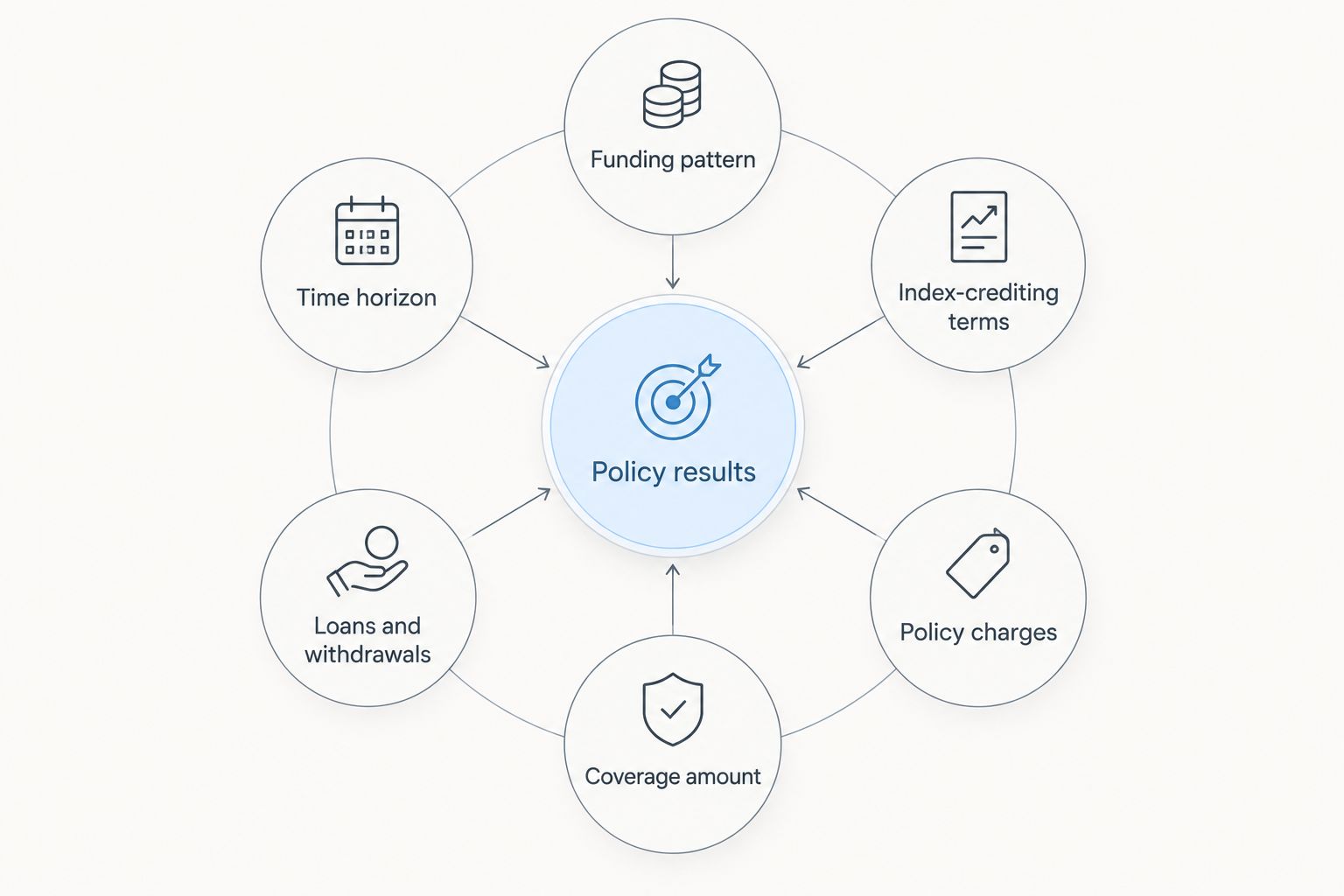
Why indexed universal life results vary
- Funding pattern. Paying less than the illustrated premium leaves less room to absorb charges and weak crediting. Flexible premiums do not mean every payment level sustains coverage.
- Index-crediting terms. The selected index is only one input. The contract’s cap, participation rate, spread, and crediting method determine the interest applied to cash value.
- Policy charges. Insurance and administrative deductions affect the account regardless of how an index performs. Check which charges the insurer can change.
- Coverage amount. The death benefit you choose affects the insurance costs the policy must support. Compare illustrations built around the same protection need.
- Loans and withdrawals. Taking money from the policy changes the cash value available to cover charges and can reduce benefits. The effect depends on the contract and what remains outstanding.
- Time horizon. A policy intended for lasting coverage needs a funding plan you can maintain. Ask what happens if your circumstances change before you rely on projected cash value.
In 2026, these factors matter more than a single projected return. Ask for an illustration that shows how the policy behaves under less favorable crediting assumptions, then identify the point at which additional premiums become necessary to keep coverage in force.
How to decide before you apply
- Define the coverage need. Write down who depends on the death benefit and whether that need ends or continues. Do not choose a cash-value feature before deciding what protection the policy must provide.
- Compare policy types on the same goal. Ask how term life, whole life, and indexed universal life each address that need. A comparison based only on projected cash value leaves out the reason for buying insurance.
- Read the illustration’s assumptions. Separate guaranteed contract provisions from non-guaranteed projections. Identify the credited-interest assumptions, planned premiums, charges, and projected cash value. An illustration explains a scenario; it does not lock in future results.
- Test a weaker outcome. Ask how lower credited interest or interrupted premium payments would affect the cash value and coverage. Find out what notice you would receive if additional funding became necessary.
- Check access and exit terms. Review loan provisions, withdrawal effects, and surrender terms before treating cash value as readily available money. Ask a qualified tax professional about the consequences of accessing value or allowing a policy with an outstanding loan to lapse.
The strongest reason to choose indexed universal life in 2026 is a protection need the policy can meet under assumptions you understand and a funding plan you can maintain. Projected cash value alone is not enough. Mxmcompass financial guidance is best used to place that insurance decision alongside your other planning priorities, not to replace a close reading of the proposed contract.
Related questions
Is indexed universal life better than term life insurance?
Indexed universal life is not better than term life for a defined coverage period by default. Term life is the simpler starting point when you need protection for a specific stretch of time and do not need a cash-value account. Indexed universal life deserves consideration when the longer-term coverage and cash-value structure address a need you can explain.
Can you lose money in an indexed universal life policy?
Yes, your cash value can decline even if the index-crediting formula has a floor. Policy charges continue, and loans or withdrawals can further reduce the value supporting coverage. Check the contract’s values and deductions rather than equating a crediting floor with protection of every premium paid.
What happens if you stop paying premiums?
Coverage can lapse if available cash value cannot cover ongoing policy charges. Flexible premium terms let you vary payments within the policy rules; they do not remove the cost of insurance. Ask the insurer how missed payments affect your specific policy before relying on cash value to carry it.
FAQ
Is indexed universal life insurance worth it for retirement income?
Not as a stand-alone retirement income plan. Policy loans can reduce cash value and the death benefit, and an outstanding loan can create complications if coverage lapses.
Does indexed universal life insurance invest in the stock market?
No. The policy credits interest according to a formula linked to an index; its cash value does not directly own the index’s shares.
Can indexed universal life insurance lose cash value?
Yes. Insurance and other policy charges can reduce cash value even when the interest-crediting formula has a floor.
Is indexed universal life insurance better than whole life insurance?
Neither is better for everyone. Indexed universal life offers premium flexibility and index-linked crediting, while whole life generally offers more predictable policy terms; compare both against the same coverage need.
What should I check in an indexed universal life illustration?
Check planned premiums, policy charges, guaranteed provisions, non-guaranteed projections, and what happens under weaker crediting assumptions. Ask when additional funding would be needed to keep coverage in force.
Do indexed universal life loans have to be repaid?
An unpaid policy loan can reduce the death benefit and affect whether the policy stays in force. Review the contract’s loan-interest terms and the consequences of a lapse before borrowing.
One last thing
In 2026, ask the person presenting an indexed universal life illustration to show where the contract ends and the projection begins. The index named on the page is not the amount your cash value automatically earns. If you cannot explain the charges, crediting limits, and funding needed to keep coverage in force, pause the decision. Mxmcompass can support the broader insurance-planning discussion; the proposed policy’s own terms must support the purchase.